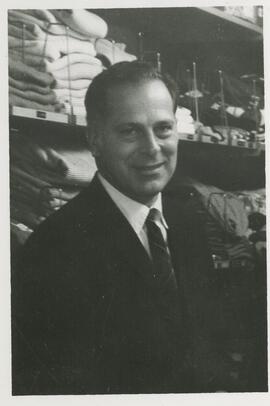
Mr. Balfanz, a child of German immigrants raised in Rock Elm, discusses his hometown and the changes he has seen over the years. He details his US Army experiences while stationed on the Mexican border in 1918. He also talks about his schooling and the various jobs he has worked.
Family
17 Archival description results for Family
Mrs. Buckley, a resident of Prescott, describes both her early and married lives. She also details her experiences with the logging inndustry and the political offices her father held.
Miss Burkhardt was a German citizen who immigrated to the United States in the early twentieth century. In this interview she relates some of the early history of the area around Burkhardt, Wisconsin, named for her father. This transcript, hpwever, is completely disorganized and badly put together due to the poor quality of the original tape.
In this interview, Mrs. Calhoun, 85, reminisces about her early life in this area while covering a variety of interesting subjects. The interview was put together very well and Mrs. Calhoun is extremely alert and articulate during the conversation.
Mrs. Chappelle was born in Kinnickirurl.c Township, St. Croix Cowity,
in 1888. She moved to Washburn County in 1913, and lived there until
the time of her death in 1972. She was the area historian and a correspondent for the Rice Lake (Wisconsin) Chronotype for 29 years. The interview deals mainly with the lumber industry am the men who brought it to Washburn County. She includes infomation on the Onaha Railroad, the Knapp-Stout Lumber Company, and local lumber companies am area sawmills in her discussion. Mrs. Chappelle is the author of The Why of Names in Washburn County, am the taped interview is followed by thirty minute program in which Mrs. Chappelle discusses the writing of the book. The Why of Names in
Washburn Cowity is om file at the Area Research Center located on the campus of the University of Wisconsin-River Falls.
During this interview, Dr. Epley recalls the life of a country doctor in the River Falls and New Richmond area. Dr. Epley is an extremely intelligent and alert individual and his experieces make for a very interesting interview.
A majority of the photographs in this folder are portraits of Chancellor Field. others include group photographs with students and his family.
This is a good interview although Mr. Flick's memory fails him at times. The interview does offer some insights into early logging and farming in Wisconsin. Flick even remembers the Populist and Progressive parties and talks at length about the 1890 and 1930's depressions.
Mr. Graslie, lifetime resident of the Upper Midwest, begins the interview with a brief description of his grandfathers life in Norway and his father's emmigration to Baldwin, Wis. in 1869. He talks about life in Norway, what convinced his father to emigrate, and the route his father travelled. He then goes on to describe his own life in the St. Croix and Pierce County areas such as his schooling, work and a farmer. and work as a carpenter. He also describes the Gilman Cheese Factory. The bulk of the interview deals with Spring Valley, Wis., where Mr. Graslie settled and became a banker. He describes banking in the area, as well as conditions of the village over the years, the settlers who came to the area, and the businesses that existed. His recollections of the mining industry tells of both the men who worked in the mines and those who owned them. He talks about the operation of smelters and the manner in which the operations dissapeared. Mr. Graslie also describes the 1942 flood and a plan that had been made to move the entire village to a safer location.

An interesting, well put together interview with Colonel Walter J. Hoar who actively participated in World War I as a stretcher-bearer and worked in the states with the Army Corp of Engineers. Colonel Hoar has also written a book about the early lumber industry in Wisconsin.
This is a good interview with William Kohl, 85, and long time resident of the River Falls area. Mr. Kohl reminices about his early days in the area and the changes that have taken place over the years.
Mrs. Oberg discusses her family background and her memories of her childhood in the Hager City area. The last few minutes of the interview deal with Mrs. Oberg's recollections of her two years at the River Falls Normal School. Mrs. Oberg is practically unintelligeble.
Miss Peck, 85, reminisses about her life in the Hayward area. She has an interesting family background and her commends on the early history of Hayward are quite worthwhile.
Mr. Phillips talks about his early life in Clear Lake, Wisconin, and also discusses some of the early history of the area.
This is a well conducted interview with Mrs. Carl Shapiro, and early resident of the Minneapolis area. Mrs. Shapiro has some interesting stories to tell as well as offering some insight into the conditions in Virginia, Le Seure, Shakopee, and Minneapolis, Minnesota in the early 1900's. At 81, Mrs. Shaprio is extremely alert and a good conversationalist.
Mr. Shue, 98, has lived in Hayward, Wisconsin since 1903. During the interview Shue talks about the Hayward area with particular emphasis placed on the logging industry, farming, and early transportation.
Mrs. Slack and Mrs. Cole relate information reagarding James Ruben Rice, and early settler of Prescott, Wis. and his son, David Oren Rice. The women also provide information regarding the Rice families and their connections with Prescott and Pierce County history.