
UWRF Series 150
·
collection
10 results with digital objects
Show results with digital objects
UWRF Series 87
·
collection
·
1942-1978
In 1942, a chapter of the Association of Wisconsin Teachers Colleges (AWTC) was formed on the River Falls campus. The name later changed to the Association of Wisconsin State College Faculties (AWSCF), reflecting the liberal arts granting privileges in the 1950’s. In the early 1960’s, with the addition of graduate offerings at the state colleges, the name changed again, this time to the Association of Wisconsin State University Faculties (AWSUF). In 1972, after the merger of the Wisconsin State Universities and the University of Wisconsin System, the name changed to The Association of University of Wisconsin Faculties (TAUWF). The organization’s purpose is to promote the general educational welfare of UW universities and to promote the economic welfare of the faculty.
The collection contains materials from the state and local chapter levels. The acronym AWSUF is used for some folder labeling purposes, even for materials that predate that designation in Box 2.
UWRF Series 45
·
collection
·
1965-1984
This series contains the general correspondence and circular letters of the Assistant Chancellor. The main duties of the Assistant Chancellor were to direct and coordinate the summer session, international study programs and to carry out special assignments at the direction of the Chancellor. Reporting to the Assistant Chancellor were college deans and graduate school. Other departments of oversight include Media Relations, Printing and Design, and the Fast Copy Center. Special assignments from the Chancellor included working on budgets for academic programs, scholarships, general admission questions, the University Press, Foundation, Alumni, minority services, and outreach programs, faculty in committee assignments, student advising, and class contacts.
University of Wisconsin--River Falls. Office of the Assistant Chancellor. (1965)
UWRF Serise 133
·
collection
·
1945-1974.
UWRF Series 163
·
collection
·
1964-1992.
The position of Assistant Chancellor for Administration and Finance came into existence in 1991 when the two offices of Assistant Chancellor for Administration and Assistant Chancellor for Business and Finance were merged. This was brought on by the retirement of Ted Kuether (Assistant Chancellor: Business and Finance) in 1991. Virgil Nylander, former professor in the Psychology Department, was appointed to the Assistant Chancellor: Administration position in 1987 and assumed this new position in 1991. In November 1995, the title of this position changed to Vice Chancellor for Administration and Finance.
Assistant Chancellor for Administration and Finance
UWRF Series 46
·
collection
·
1953-1975
This series contains miscellaneous administrative files including Assembly Bill 800 establishing the College of Veterinary Medicine in 1969; draft materials relating to the 1974 centennial catalog; university mission statements (1968-1975); materials on Brotherhood Week, Campus Community Day and the annual publication luncheon for former Student Voice and Meletean employees; Salary Committee records including procedures used in awarding faculty salary increases and sample faculty rating forms (1969-70); a 1965 study on the university's image in the community conducted by journalism professor, Don Brod; and miscellaneous materials including grant proposals, travel requests and scholarship recipient lists.
Wolfe, Wayne
US ARC St. Croix Series 67
·
collection
·
1939
US ARC St. Croix Series 49
·
collection
·
1931 - 1935
Records of property ownership, type of land, building data, and tax assessments for real estate.
US ARC River Falls SC 281
·
collection
·
1883-1926 and undated
Copies of letters, 1883-1886, to Stanchfield from his fiancee, Maud who taught school in Richardson and Clear Lake, Wisconsin; and other family letters, 1896-1926, n.d., including several from Maud's cousin Annie (Mrs. George) Van Alstine of Hastings, Minnesota.
US ARC River Falls Mss DJ
·
collection
·
1915-1971
Papers of a dairy and animal husbandry professor at Wisconsin State College, River Falls, consisting of personal papers, course notes and lectures, papers from his local civic activities, family papers, and photographs including some of agricultural scenes.
US ARC River Falls SC 192
·
collection
·
1952
Transcript of a 1952 radio speech to the people of Pierce County, Wisconsin, by State Assemblyman Arthur L. Peterson in which he attacks the methods of Senator Joseph R. McCarthy.
US ARC River Falls SC 382
·
collection
·
1918-1919
Two letters written by Chapman to his mother and sister Ella in River Falls, Wis., while he was working as a riveter at the Hog Island Shipyard near Philadelphia, describing his living conditions and work at the shipyard.
UWRF Series 64
·
collection
·
1951-1983.
Prior to 1954 the University of Wisconsin – River Falls only offered an art minor designed primarily for Elementary Education Majors. This was expanded in 1954 to a dual offering: Minors in both Art and Art Education. The Art major was instituted in 1960, also in a dual role. The major was offered in Art and in Art Education. The Art major required 48 credits and Art Education totaled 60 hours. The coursework differentiation was primarily related to extra coursework in teaching art to public school-age students for the Art Education majors. In 1964 a Broad Area Art Education major was introduced for majors who preferred not to seek a minor but to strengthen their major. This course required 21 credits beyond the 60 for the Art Education majors. The Liberal Arts major, as it came to be known, remained at 48 credits. In 1969 a Broad Area Liberal Arts Program began. This degree required a minimum of 69 credits in art and was designed to give the non-education-orientated student a stronger base for professional or graduate directions in art.
US ARC River Falls SC 328
·
collection
·
undated
History of the Madson Lumber and Flooring Company of Spring Valley, Wisconsin, 1898-1978, by Arnold Madson. Genealogical information regarding the Madson Family, 1843-1962, compiled by Stella Madson Carpenter, is also included, as are copies of Madson Lumber Company brochures, information regarding the Spring Valley earthen dam, and a list of articles that have appeared in "The Spring Valley Sun" regarding Madson Lumber.
US ARC River Falls Mss DI UW-River Falls
·
collection
·
1914-1970
Papers of a Minnesota farm family that also had connections in La Crosse, Wisconsin. Included are correspondence from family members who served in the military during World Wars I and II, two brief diaries of Laura Sheldon Arnet from the l940's describing her life when she managed the farm alone, photographs, and financial records of the farm ranging from the late l920's to l970.
The military correspondence concerns daily life rather than combat and chiefly focuses on training, life in the trenches, and the post-war occupation of Japan. The financial records provide information on record-keeping practices on a family farm and some summary data on its overall economic condition.
UWRF Series 104
·
collection
·
1906-1909.
The Areopogus Society was formed in 1906 on the River Falls campus. The main purpose of the society was for the intellectual and moral advancement of its members.
US ARC River Falls SC 9
·
collection
·
1842-1931
Papers of Antoinette (Mrs. James Monroe) Bailey including reminiscences of her family's move in 1842 from Saratoga County, New York via northern Illinois to Rock County, Wisconsin; an account of the founding of early churches in Prescott, Wis.; histories of Clifton Hollow, Pierce County, Wis., written by Mary Bascom Wheelock and her brother, Frank Bascom; a talk delivered by Mrs. Bailey at a family reunion, ca. 1895-1900; and a eulogy of Mrs. Bailey. Brief genealogical information is present on the following family names: Bailey, Case, Cornish, Crippen, Ellsworth, Fuller, Hazeltine, Karner, Kelsey, Loomis, Meloon, Palmer, Scott, Shatswell, Stark, Treat, Tullar, Webster, White, and Wolcott.
UWRF Series 21
·
collection
·
1956-1968.
Annual Reports from the Schools of Agriculture, Education and Arts and Sciences (Colleges after 1962/63) to the President. Also includes annual reports from the Library, the Student Personnel Division, and the Graduate School, (1964/65-1967/68). Reports include accomplishments, activities, and recommendations.
Office of the President
UWRF Series 22
·
collection
·
1934-1957.
Enrollment statistics; including enrollment by terms and classes, and distribution of students by year, department and division; scholastic data; summaries of transfers, graduates and withdrawals.
Office of the Chancellor
UWRF Series 215
·
collection
·
1977-Present
Early reports include an annual overview of department activities and initiatives undertaken by Campus Security. These reports are published to compy with federal law, the Clery Act, which requires colleges and universities to disclose certain timely and annual information about campus crime and security policies. Incident statistics include; criminal offenses, such as theft, assault, drug, and alcohol use, and other complaints brought to the police and security officers. In 2014, incidents involving fires on campus were included.
University Police, 2009
US ARC River Falls SC 195
·
collection
·
1900-1959
Miscellaneous items concerning Morrow's family and youth in Clifton Hollow, Pierce County, Wisconsin; including souvenir pupil lists, 1900-1905, from Clifton Hollow School; a 1959 letter from Dean S. Smith discussing his ancestors in Clifton Hollow; and a 1941 clipping about Mrs. Morrow's father, Nicholas Kohl.
US ARC River Falls SC 124
·
collection
·
circa 1970
Reminiscences by Mrs. Anderson in which she discusses her childhood in Pierce County, Wisconsin, at the turn of the century.
US ARC River Falls SC 130
·
collection
·
1924
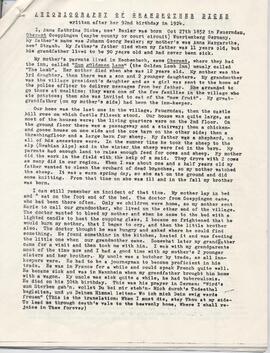
Autobiography written by Mrs. Peter Heinrich Dicke; including recollections of her youth and schooling in Eschenbach, Germany, her 1849 immigration to America, and her subsequent employment and marriage to Pastor Dicke.
US ARC River Falls Mss EO
·
collection
·
1918-1939
Five diaries of Anna (Caruthers) Corcoran (Mrs. W.P. Corcoran) who lived near River Falls, Wisconsin, documenting rural life and agriculture in the years 1918, 1922, 1923-1925, 1926-1928, and 1934-1939. The diaries provide insight into family relations especially her relationship with her husband's parents and brothers. Subjects documented include her day to day activities and the activities of others in her household, including trips to town, daily chores, and various social activities.
US ARC Pierce Series 102
·
collection
·
1942-1960
[1] Teacher's Register (1953-1957) with names of teachers and pupils, attendance record, remarks concerning the promotion and progress of students, and a register of visitors; [2] Financial Records indicating the balance in the district's bank account (1942-1960), and a Cash Disbursement and Receipts Ledger (1954-1960) which shows the names, amounts, and dates of financial transactions; and [3] Annual Report (1960) which has information on enrollment, school district expenses, and financing.
US ARC River Falls SC 74
·
collection
·
1980
An account, written in 1980, of Johnson's experience pledging the PEX fraternity at the University of Wisconsin-Superior in 1977, detailing the violent and dehumanizing acts perpetrated on the pledges by members.
US ARC River Falls Mss AX
·
collection
·
1894
Papers concerning members of the Andrew Monteith family who immigrated to Grant County, Wisconsin, from Scotland; consisting of letters, tax receipts, genealogical information, and a hymnal, "The Missouri Harmony." Included are negative photostat copies of a few Civil War letters from his sons, Samuel and Robert, both serving in the 7th Regiment Wisconsin Volunteers; church certificates (1852) of David and Andrew Monteith from the Parish of Penningham, Scotland; and a letter (1862) from David Monteith describing his trip from New York via Panama to San Francisco and Washington Territory to mine for gold.
US ARC River Falls SC 319
·
collection
·
1779-1925
Photocopies of genealogical charts, illustrations, and written description of the history of the Andrew Malgren family of Hudson, Wisconsin, compiled by Swanson. Other surnames treated in the genealogy, 1779-1925, include Plato, Persson, Lindstrom, and Erickson.
US ARC River Falls SC 413
·
collection
·
1858-1862
Typed translations of 3 letters written to friends and family in Tonset, Norway by brothers Anders and Ole Stortroen, immigrant residents in Martell Township, Pierce County, Wisconsin; including detailed information on farming, building houses, pay rates and prices, the availability of churches and schools, and references to the Civil War.
UWRF Series 74
·
collection
·
1939-1980.
The first three boxes of this series deal with the practice reports of student teachers at the predecessor lab school located in North Hall. Boxes 4-6 contains correspondence, scrapbooks, reports, and other information concerning the lab school.
US ARC River Falls Mss CW
·
collection
·
1940-1950
Records of the Polk County Red Cross, principally correspondence between chapter officers and volunteers and materials received from the national Red Cross. The records concern the making of knit garments and surgical dressings for use by the armed forces, and peacetime activities of the chapter.
US ARC River Falls SC 16
·
collection
·
1917-1964
A history of the chapter, an authorization to organize, by-laws, and minutes of meetings.
US ARC River Falls Mss AJ
·
collection
·
1922-1997
Records documenting the activities of a local post of the American Legion, mainly its Auxiliary, including community service projects, aid for veterans and their dependents, post building bonds, and promotion of the annual "poppy drive." The collection contains minutes, reports, correspondence, financial records, and scrapbooks including photographs and news clippings.
US ARC River Falls Mss AA
·
collection
·
1920-1930
Records of the Post, including correspondence, 1924-1930; minutes, 1920-1928; receipts and requisitions, 1928-1930; and membership lists.