
US ARC River Falls Mss H-13.A.4.1-13.A.4.1
·
undated
Part of Willow River Power Company records, 1866-1953.
9204 results with digital objects
Show results with digital objects
US ARC Polk Series 30-7.D.1.1
·
1889-1925
Part of Polk County, Wisconsin. Clerk. Apportionment of state and county taxes and charges, 1889-1968 and undated.
US ARC Polk Series 30-7.D.1.2
·
1926-1968
Part of Polk County, Wisconsin. Clerk. Apportionment of state and county taxes and charges, 1889-1968 and undated.
UWRF Series 18-17.D.2.2
·
1977
Part of National Council for Accreditation of Teacher Education (NCATE), 1955-1997.
US ARC -27.B.41.1
·
folder
·
1949-1992
Part of Hudson Star Observer
UWRF Series 130-21.D.3.9
·
1974-1975
Part of William Munns, Dean of Students Subject Files, 1967-1990.
UWRF Series 26-UWRF26_179
·
circa 1930's-1960's
Part of University Photograph collection, 1875-
1962 - 2010
Part of UWRF Subject Files, 1874-Present
Archives and ARC Brochure, Newspaper Clippings, Invitation, Magazine Articles, Magazine, Flyers
UWRF UWRF 240-24.F.4
·
1969-1982
Part of College of Arts and Sciences Dean Administrative Subject Files
handouts, correspondance, reports
UWRF Series 104
·
collection
·
1906-1909.
The Areopogus Society was formed in 1906 on the River Falls campus. The main purpose of the society was for the intellectual and moral advancement of its members.
UWRF Series 44-19.C.3.2
·
1941-1946.
Part of Alumni in Armed Forces, 1941-1945.
US ARC -27.B.41.1
·
folder
·
c. 1900s
Part of Hudson Star Observer
US ARC -27.B.41.1
·
folder
·
1916
Part of Hudson Star Observer

UWRF Series 26-UWRF26_317-33
·
item
·
1967
Part of University Photograph collection, 1875-
US ARC -27.B.41.1
·
folder
·
1953-1970
Part of Hudson Star Observer
1953, 1991
US ARC River Falls Mss DI UW-River Falls
·
collection
·
1914-1970
Papers of a Minnesota farm family that also had connections in La Crosse, Wisconsin. Included are correspondence from family members who served in the military during World Wars I and II, two brief diaries of Laura Sheldon Arnet from the l940's describing her life when she managed the farm alone, photographs, and financial records of the farm ranging from the late l920's to l970.
The military correspondence concerns daily life rather than combat and chiefly focuses on training, life in the trenches, and the post-war occupation of Japan. The financial records provide information on record-keeping practices on a family farm and some summary data on its overall economic condition.
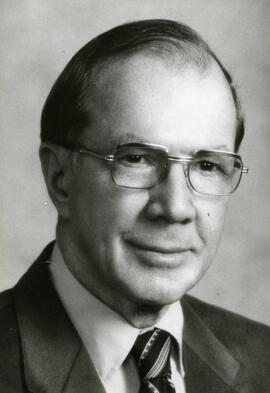
UWRF Series 26-UWRF26_102-5
·
item
·
n.d.
Part of University Photograph collection, 1875-
US ARC River Falls SC 328
·
collection
·
undated
History of the Madson Lumber and Flooring Company of Spring Valley, Wisconsin, 1898-1978, by Arnold Madson. Genealogical information regarding the Madson Family, 1843-1962, compiled by Stella Madson Carpenter, is also included, as are copies of Madson Lumber Company brochures, information regarding the Spring Valley earthen dam, and a list of articles that have appeared in "The Spring Valley Sun" regarding Madson Lumber.
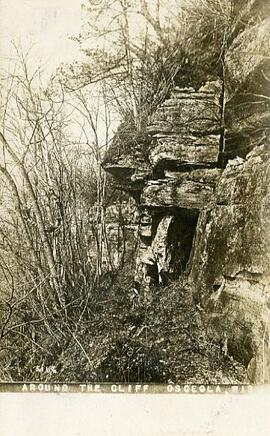
US ARC PH 2017.001.082
·
item
·
circa 1909
Part of Photographic postcard collection
Date from postmark: Oct 8, 1909; mailed from Osceola Wisconsin; green 1¢ Franklin stamp.
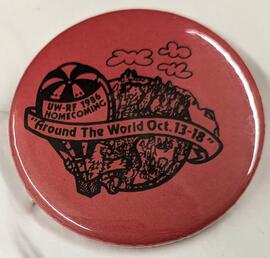
UWRF Series 229--.012
·
1986
Part of 3D items and Textile collection
UW-RF 1986 Homecoming "Around the World Oct. 13-18"
US ARC River Falls Mss FB-15.F.3.2
·
1945
Part of Richard P. Rivard papers, 1941-1945.

US ARC PH 2017.003.041
·
item
·
undated
Part of Photographic postcard collection
US ARC -27.B.41.1
·
folder
·
1968-1980
Part of Hudson Star Observer
2nd and Vine, 1968, 1977, 1980, 1968
UWRF Series 64-19.F.4.3
·
1966-1970
Part of Art Department: Subject Files, 1951-1983.
US ARC River Falls Mss AT-14.E.1.1
·
1963-1973
Part of St. Croix-Pierce Bi-County Federation of Women's Clubs records, 1922-1973.
UWRF Series 24-17.D.1.7
·
1969.
Part of Building projects, construction and maintenance files, 1914-2011.
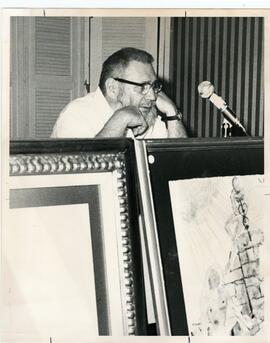
UWRF Series 61-19.E.2.6-35
·
item
·
1976
Part of WRFW-FM radio station records, 1968-2018.
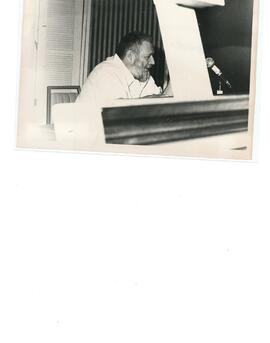
Howard Mann Auctioneer, 1976
UWRF Series 61-19.E.2.6-36
·
item
·
1976
Part of WRFW-FM radio station records, 1968-2018.
Howard Mann
UWRF Series 137-21.F.1.1
·
1945-1946, n.d.
Part of Haddow, Lovina Lucile Papers & Lecture Notes, 1895-1953.
UWRF Series 26-UWRF26_216-054
·
item
·
1950's
Part of University Photograph collection, 1875-
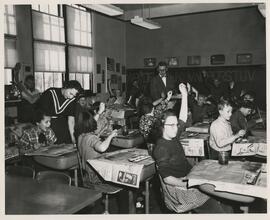
Students raising their hands during art class, painting on newspapers. , North Hall,
UWRF Series 26-UWRF26_340
·
1970's-1980's
Part of University Photograph collection, 1875-
UWRF Series 26-UWRF26_339
·
circa 1900-1960's
Part of University Photograph collection, 1875-
UWRF Series 26-UWRF26_216-041
·
item
·
1910's-1950's
Part of University Photograph collection, 1875-
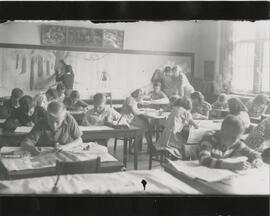
Univ-Elementary, Art Classroom, Campus School, North Hall Lab School, , J. P. Jacobson Coll.
UWRF Series 64
·
collection
·
1951-1983.
Prior to 1954 the University of Wisconsin – River Falls only offered an art minor designed primarily for Elementary Education Majors. This was expanded in 1954 to a dual offering: Minors in both Art and Art Education. The Art major was instituted in 1960, also in a dual role. The major was offered in Art and in Art Education. The Art major required 48 credits and Art Education totaled 60 hours. The coursework differentiation was primarily related to extra coursework in teaching art to public school-age students for the Art Education majors. In 1964 a Broad Area Art Education major was introduced for majors who preferred not to seek a minor but to strengthen their major. This course required 21 credits beyond the 60 for the Art Education majors. The Liberal Arts major, as it came to be known, remained at 48 credits. In 1969 a Broad Area Liberal Arts Program began. This degree required a minimum of 69 credits in art and was designed to give the non-education-orientated student a stronger base for professional or graduate directions in art.
UWRF Series 216-24.F.4.2
·
1988-2000.
Part of Academic Program Review Records, 1962-2009

US ARC PH 1993.033.002
·
item
·
[1950s]
Part of Photographic postcard collection
Real-photo postcard with image of a roadside art display. Text printed on verso: A. Pearson Co., Inc., Minneapolis, Minn. All Rights Reserved. Printed on Kodak paper (used 1950- ). Unused.
2014 - 2017
Part of UWRF Subject Files, 1874-Present
Art Handouts, Brochures, postcards
UWRF Series 26-UWRF26_338
·
circa 1960-1980's
Part of University Photograph collection, 1875-
UWRF Series 26-UWRF26_252
·
1970's-1980's
Part of University Photograph collection, 1875-
UWRF Series 1-1987-16.D.5.6
·
1974-1984.
Part of UWRF Administrative subject and correspondence files, 1896-ongoing.
Annual report
UWRF Series 233-24.D.4.1
·
1980
Part of West Central Wisconsin Consortium Records, 1973-2001.
UWRF Series 216-24.F.4.2
·
2009
Part of Academic Program Review Records, 1962-2009
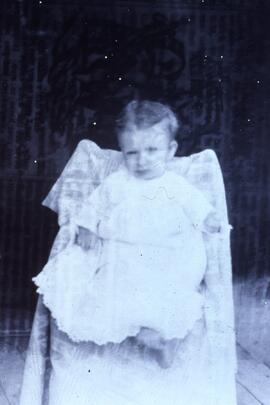
circa 1890
Part of Charles Francis Smith photographs, 1887-1893
Index card notes that there isn't anything known about this baby.
Smith, Charles Francis
UWRF UWRF 240-24.F.4
·
1963-1988.
Part of College of Arts and Sciences Dean Administrative Subject Files
handouts, posters, workshop information, correspondance, department background, gallery schedule, annual gallery report,departmental reorganization, safety, course proposals.
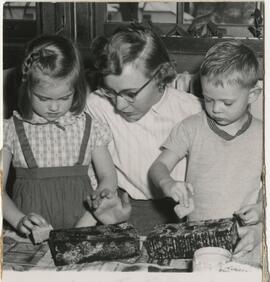
UWRF Series 26-UWRF26_216-020
·
item
·
1950's
Part of University Photograph collection, 1875-
North Hall, Lab School
US ARC River Falls SC 382
·
collection
·
1918-1919
Two letters written by Chapman to his mother and sister Ella in River Falls, Wis., while he was working as a riveter at the Hog Island Shipyard near Philadelphia, describing his living conditions and work at the shipyard.